
What Are Montmorency Cherries?
Short answer: Montmorency cherries are a bright red tart cherry variety and the most widely grown tart cherry in the United States. They are named for the Montmorency Valley near Paris, France, where they were grown for centuries, and they are the main cherry grown in Michigan. Their tangy flavor makes them the classic cherry for pies, and most are sold frozen, dried, canned or as juice.
If you have eaten a slice of tart cherry pie or a handful of dried tart cherries in the United States, you have almost certainly eaten Montmorency cherries. Here is where they came from and what makes them different.
What Montmorency cherries look and taste like
Color: bright, shiny red skin with pale yellow flesh and clear juice.
Flavor: tangy and sour, with a sweet finish when fully ripe. Most people find them too tart to eat raw in large amounts.
Texture: soft and juicy, which is why they bruise easily and are processed soon after harvest.
Size: smaller than most sweet cherries like Bing.
Where Montmorency cherries come from
The variety is believed to come from the Montmorency Valley north of Paris, where it was grown for centuries and named after a noble family. French settlers brought tart cherries to North America, and the Montmorency was grown commercially in the United States starting in the late 1800s.
In Michigan, the story starts in 1852, when Presbyterian missionary Peter Dougherty planted cherry trees on the Old Mission Peninsula north of Traverse City. The first commercial tart cherry orchards followed nearby in 1893. Lake Michigan's moderating effect on winter cold and spring frost proved ideal for tart cherries, and the region became the center of the American tart cherry industry.
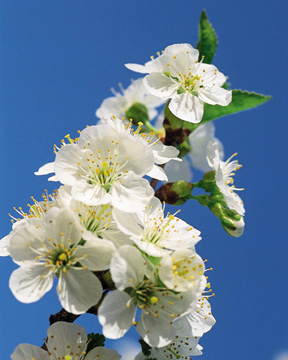
Cherry blossoms in spring. Each blossom that sets fruit becomes a cherry by summer.
Where Montmorency cherries are grown today
Montmorency is by far the most common tart cherry in the United States. Michigan grows most of the country's tart cherry crop, about 70 percent in a typical year, with smaller crops in Utah, Washington, Wisconsin and New York.
How Montmorency cherries are sold
Frozen: pitted and ready to bake. See what to do with frozen tart cherries.
Canned: packed in water or light syrup. See our canned tart cherry recipes.
Dried: chewy and sweet-tart, great in baking, salads and trail mix.
Juice and concentrate: for drinks, sauces and glazes.
Fresh: only for a few weeks in July, mostly near the orchards.
Why bakers love Montmorency cherries
Sweet cherries can taste flat once they are baked. Montmorency cherries keep their bright, tangy flavor through sugar and heat, which is why they are called pie cherries. Try them in our Classic Michigan Tart Cherry Pie or tart cherry crisp.
Frequently asked questions
Are Montmorency cherries the same as tart cherries?
Montmorency is one variety of tart cherry, but it is so dominant in the United States that most tart cherry products here are Montmorency. Another variety, Balaton, is also grown in Michigan.
Are Montmorency cherries the same as sour cherries?
Yes. Tart cherries, sour cherries and pie cherries are different names for the same type of cherry, and Montmorency is the most common variety.
Can you eat Montmorency cherries raw?
Yes, but they are very tart. Many people prefer them baked, cooked into sauces or dried.
When are Montmorency cherries harvested?
In Michigan, usually from about mid-July into early August. See when Michigan cherries are in season.
About the author: Andy LaPointe founded NationalCherryMonth.com and co-founded Traverse Bay Farms, a family-owned Northern Michigan tart cherry company, in 2001. He has spent more than 25 years working with Michigan cherries.
